
The honest cost of dubbing is not one vendor's price divided by video length. Your budget depends on source minutes, target languages, quality controls, revisions, publishing work, and whether the quoted unit includes the complete deliverable.
The Unit That Makes Dubbing Costs Comparable
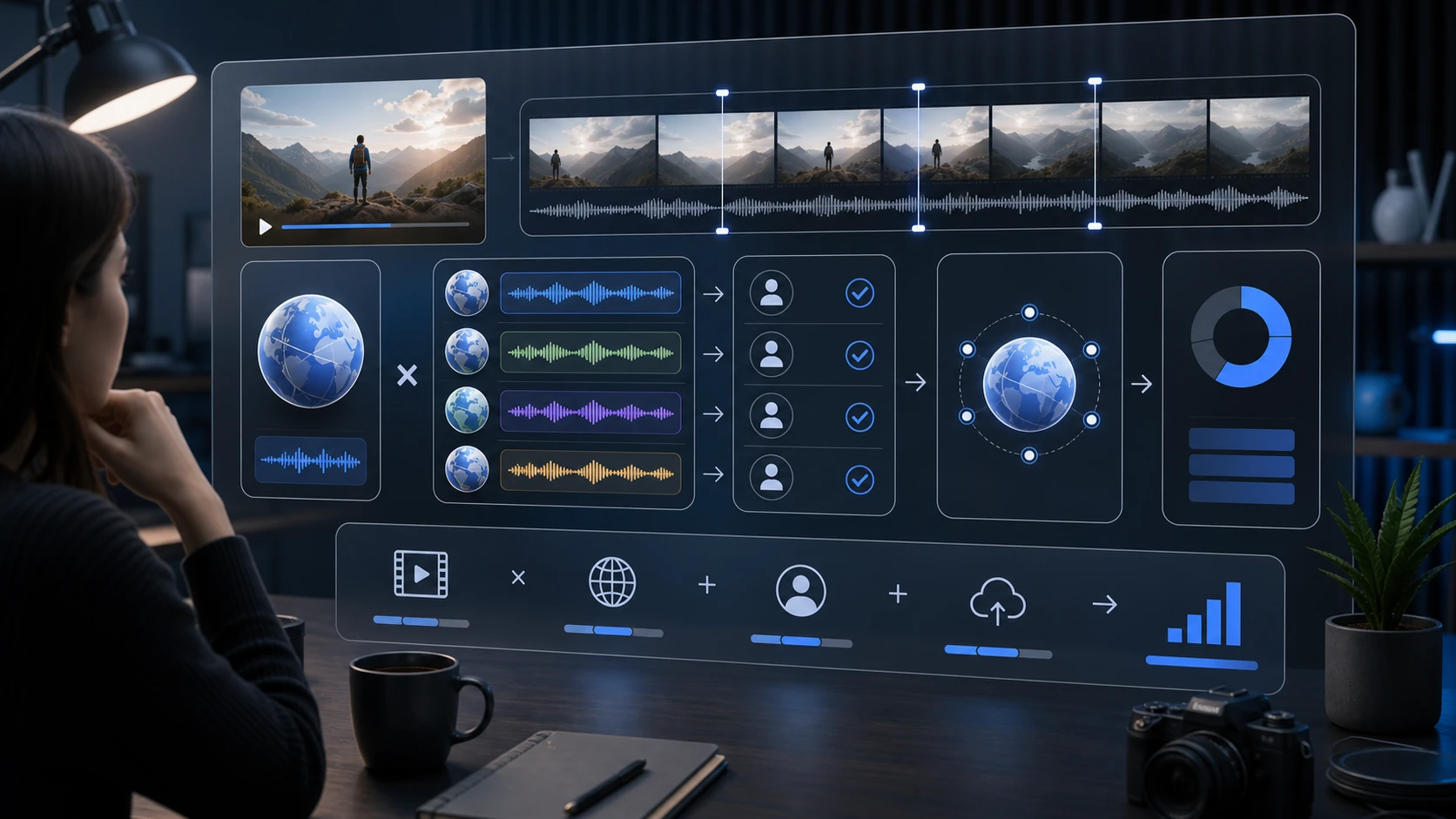
Start with language-minutes: the source duration multiplied by the number of target languages. A ten-minute video dubbed into Spanish, Portuguese, and German creates 30 language-minutes of work.
10 minutes × 3 languages = 30 language-minutes
This is the useful starting point, not the final invoice. A platform may bill per source minute, per generated minute, per credit, or per plan allowance. Some vendors count each target language separately. Others bundle language output in ways that are not obvious from the plan headline. Confirm the billing unit before doing the math.
Four Different Things People Mean by "Dubbing Cost"
2026 Pricing Snapshot: What the Public Pages Actually Say
The table below records public plan information retrieved on July 23, 2026. It is a snapshot, not a permanent quote. Vendor prices, allowances, watermarks, language coverage, and plan terms can change.
Swipe horizontally to compare every column.
| Option | Public pricing signal | What the headline does not settle | Best fit |
|---|---|---|---|
| YouTube automatic dubbing | No separate product price for eligible creators and videos | No line-level editing; availability and quality vary by video and language | Low-risk content that passes creator review |
| DittoDub | $1 for the first month, then $48 monthly for 30 minutes; $97 for the first month, then $194 monthly for 120 minutes; or $194 for the first month, then $292 monthly for 180 minutes | The plan also includes workflow features such as editing, custom vocabulary, subtitles, metadata translation, and YouTube Sync | YouTube creators and teams that need reviewed, publishable language packages |
| Rask AI | Public monthly plans list $60 for 25 minutes, $150 for 100 minutes, and $750 for 500 minutes | Annual promotions, lip-sync usage, add-ons, and the exact billing unit can affect cost | Self-serve video localization and repeat production |
| ElevenLabs | Shared-credit plans start at $6 monthly; the pricing page lists 2,000 to 10,000 credits per dubbing minute depending on workflow and watermark | Credits are shared across products, so plan price alone is not a dubbing rate | Teams that also use voice, speech, music, or other credit-based tools |
| Human studio production | Usually custom quoted | Talent minimums, casting, direction, adaptation, studio time, engineering, rights, and revision terms vary by project | Broadcast, premium narrative, regulated, or high-risk brand content |
A Better Dubbing Budget Formula
A useful budget separates vendor spend from internal production time:
If your editor spends 90 minutes fixing and uploading a ten-minute dub, that labor belongs in the comparison. So does the time a bilingual reviewer spends checking names, numbers, sponsor language, speaker identity, and timing.
Worked Example: A Weekly Ten-Minute YouTube Show
Consider a creator who publishes four ten-minute episodes each month and wants Spanish and Portuguese audio.
- Source video: 40 minutes per month
- Target languages: 2
- Total output: 80 language-minutes per month
- Speakers: host plus occasional guest
- Deliverables: audio, subtitles, titles, descriptions, and YouTube upload
The wrong way to compare providers is to ask, "What does one minute cost?" The right questions are whether 80 language-minutes fit the allowance, whether both speakers are handled correctly, whether revisions consume new credits, whether metadata and subtitles are included, and who uploads and verifies the final tracks.
A $60 software plan can be a good deal if the team already has the language and audio skills to finish the job. It can be expensive if every episode creates several hours of cleanup. A managed workflow can cost more in cash and less in staff time. You need both numbers.
The Hidden Costs That Change the Decision
1. Translation and adaptation
Literal translation is often not enough for jokes, cultural references, sponsor copy, or technical explanations. Someone must decide what the line should mean in the target market and how it should fit the available time.
2. Speaker and voice control
A single-speaker tutorial is simpler than a video podcast with a host, guest, archival clip, and voice-over. Ask whether the price covers speaker detection, stable voice assignment, and manual correction when the system gets a handoff wrong.
3. Regeneration and revision rules
Credit systems may charge for new generations. Managed services may include a defined revision round. Human studios may price retakes based on who caused the change. Put revision terms in the budget before production starts.
4. Music, effects, and final mixing
A spoken track that sounds good alone may still fail against music or source audio. Loudness, background preservation, fades, and transitions are part of a publishable mix.
5. YouTube delivery
The audio track is only one part of the language experience. Localized titles, descriptions, subtitles, and thumbnails help viewers understand what the video is before they press play. Uploading the correct files to the correct language rows and checking the public player also takes time.
Which Dubbing Model Should You Pay For?
Swipe horizontally to compare every column.
| Situation | Practical starting point | Why |
|---|---|---|
| Simple educational video, clear speech, low brand risk | Review YouTube's automatic dub first | The platform-generated option may be sufficient and has no separate product charge |
| Regular creator uploads with names, sponsors, or multiple speakers | Controlled AI workflow with review | You keep speed while gaining edit, vocabulary, speaker, and approval controls |
| Large catalog with an experienced internal localization team | Self-serve or API platform | Your team can absorb QA and publishing work at scale |
| Premium narrative, regulated claims, or broadcast delivery | Managed human or hybrid production | The cost of a weak performance or factual error is higher than the software savings |
Questions to Ask Before You Accept a Quote
- What exactly counts as one billable minute?
- Does each target language consume a separate allowance?
- Are transcript corrections and translation edits included?
- Does the workflow support multiple speakers and stable voice assignment?
- Do regenerations or revisions consume new credits?
- Are subtitles, titles, descriptions, and thumbnails included?
- Who uploads the final tracks and verifies them in YouTube?
- Are usage rights and voice permissions clear?
- What happens when output exceeds the monthly plan?
- Which tasks still require your team's time?
Sources and pricing date
Public pricing was retrieved July 23, 2026. Check each linked page for current terms.