
A dubbed track with few views is not automatically a bad dub. The failure can sit in publishing, viewer language selection, localized packaging, market demand, catalog depth, quality, or the way the result is being measured.
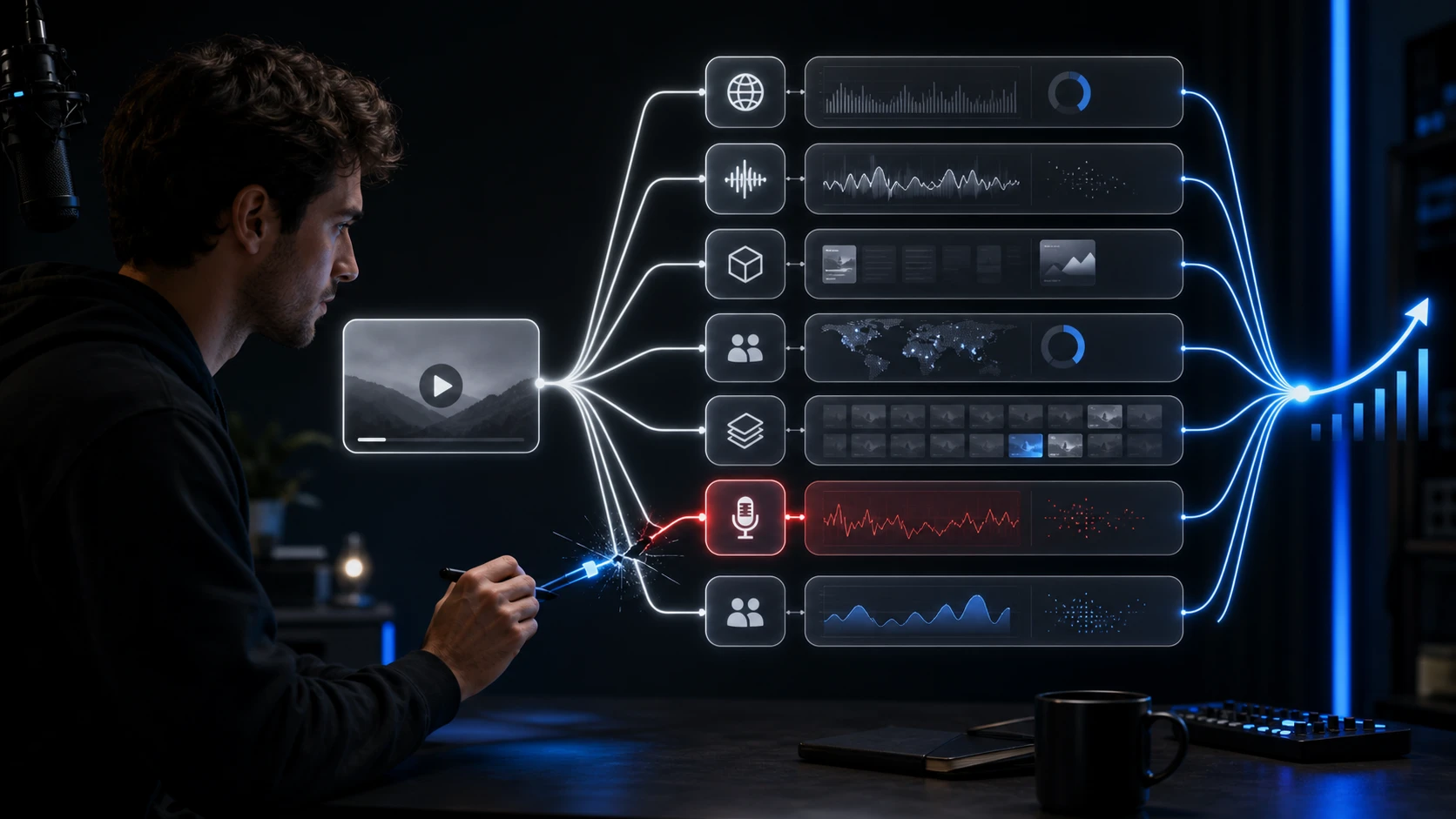
Dubbing Does Not Create Demand by Itself
Dubbing removes a language barrier. It does not guarantee that viewers want the topic, recognize the creator, see a relevant title or thumbnail, or receive the video in recommendations. It also does not guarantee that the right audio track was published correctly.
YouTube said in May 2026 that having a video dubbed does not negatively affect viewer discovery. That makes "the algorithm punished my dub" a weak starting theory. The useful question is which part of the language experience failed to create or capture demand.
The Fast Diagnostic Tree
-
Can a viewer select the track?
If no, fix the upload, language row, or publication state before investigating performance. -
Does the audio-track report show traffic?
If no, confirm the date range and track filter. If yes, record views and watch time. -
Is the video packaged for that language?
If no, localize the title, description, captions, and any thumbnail text. -
Does the topic fit the target market?
If uncertain, compare several videos and look for existing audience signals. -
Is there enough catalog depth?
If one isolated video carries the language, publish a coherent group before judging the market. -
Does the dub pass a native and technical review?
If no, repair the source, translation, voices, timing, or mix. -
Is the sample large enough?
If no, wait, deepen the test, or describe the result as inconclusive.
1. The Track Is Missing, Hidden, or Attached Incorrectly
Open the public video, use the player settings, and inspect Audio track. Do this outside YouTube Studio and, for an important release, on more than one device.
- The target language appears in the public player's audio menu.
- The expected voice and language play when selected.
- The track is attached to the intended video.
- The track is published rather than left in a review or unpublished state.
- An old automatic dub is not occupying the same language slot as the intended replacement.
YouTube requires an automatic dub to be deleted before a creator-supplied track can be uploaded in the same language. If the wrong track is present, follow the auto-dub repair and replacement guide before changing the content itself.
2. The Creator Is Reading the Wrong Report
Viewer geography, subtitle language, translated metadata, and audio language are related but not interchangeable. A viewer in Mexico can listen to the original audio. A viewer in the United States can choose Spanish.
Use YouTube Studio's audio-track filter and compare views and watch time for a period that begins after the track was published. The audio-language analytics guide explains the measurement setup and the claims the report can support.
3. The Audio Is Localized but the Click Is Not
Viewers decide whether to click before they hear the dub. If the title remains in the original language, the thumbnail text is unreadable, or the description gives no local context, the audio track cannot repair that first impression.
Swipe horizontally to compare every column.
| Asset | Failure | Repair |
|---|---|---|
| Title | Literal translation, awkward order, or unchanged source language | Write a natural target-language promise that stays faithful to the video |
| Description | Missing local explanation, links, chapters, or disclosures | Localize the complete publishing package, not only the first sentence |
| Thumbnail | Source-language text, overflow, unreadable type, or wrong cultural cue | Use a localized thumbnail workflow and inspect the result at mobile size |
| Captions | Wrong language label or captions that do not match the spoken dub | Publish target-language captions aligned to the final audio |
4. The Language Was Chosen Without Channel Evidence
Spanish has a large global audience. That fact does not prove that a specific Spanish-speaking audience wants a specific channel. Topic portability matters. So do existing geographies, comments, search behavior, sponsor markets, and the amount of evergreen content that can support a language.
Start with one or two languages that have a reason to work for the channel. YouTube recommends concentrating on depth in one or two languages when possible, rather than spreading a thin test across many languages. Use the language selection guide and the YouTube Dubbing Strategy tool to make the hypothesis explicit.
5. One Dub Is Not a Catalog Strategy
A viewer who enjoys one localized video needs another relevant video to watch. One isolated track may prove that production works, but it is a weak test of audience behavior.
YouTube's multi-language guidance recommends dubbing a substantial part of the back catalog when practical. The right depth depends on the channel. A five-part series may need all five episodes. An evergreen tutorial channel may start with several videos that already attract international viewers. The point is continuity, not a universal minimum.
6. The Dub Is Accurate but Hard to Watch
Viewers can leave because the voice changes between scenes, names are repeatedly wrong, the delivery is flat, two speakers are confused, or speech fights the music. Those defects do not always appear in a transcript review.
- A qualified language reviewer confirms meaning and natural phrasing.
- Each speaker keeps the correct voice throughout the video.
- Names, products, numbers, sponsor copy, and calls to action are correct.
- Speech starts and ends cleanly around edits.
- Music and effects do not bury the dubbed dialogue.
- The opening, speaker changes, and ending pass public playback.
Use the AI dubbing QA checklist to turn that review into a repeatable release gate.
7. The Test Is Too Small or Too Early
Small samples swing wildly. A new track may launch after most of a video's traffic has already passed. A weekly channel may need several releases before a target-language audience has enough opportunity to discover it.
Do not rescue a weak theory with endless waiting, but do not call 40 views a market verdict. Record the test window, number of videos, total views, watch time, and changes made. If the evidence is thin, say so.
Diagnosis Matrix: Symptom to Next Action
Swipe horizontally to compare every column.
| Symptom | Most likely class | Next action |
|---|---|---|
| Language is absent from the player | Publishing | Fix the language row, upload, or publication state |
| Track is live but the report shows almost no use | Distribution, packaging, or demand | Verify the filter, metadata, thumbnail, and market hypothesis |
| Views exist but watch time is weak | Content mix or quality | Compare video lengths, then run language and audio QA |
| One video works and the rest fail | Topic fit | Study the winning topic before expanding the whole language |
| Comments mention wrong names or voices | Quality | Repair terminology, speaker mapping, and review gates |
| Result changes after a title or thumbnail update | Packaging | Keep the winning change and test it across a larger set |
A Two-Week Repair Sprint
- Day 1: verify every target track in the public player.
- Day 2: freeze a post-publication analytics window.
- Days 3 to 4: review titles, descriptions, captions, and thumbnails.
- Days 5 to 7: run native-language and audio QA on the weakest videos.
- Week 2: fix one failure class and publish the next planned tracks.
- Review date: compare the same report after another complete cycle.
The sequence matters more than the calendar. Fix publishing before packaging. Fix packaging before declaring the market weak. Fix serious quality failures before buying more volume.