
Inside Erling Haaland's 44-Language YouTube Breakout
Published by Ditto Team · 5 min read · 3 months ago
Read in:ChineseHindiSpanishFrenchArabicBanglaPortuguese
Erling Haaland's public YouTube subscriber count rose from 1.64 million on June 9 to 3.7 million on July 22 while his team published through the World Cup and ran a 44-target-language localization rollout using DittoDub.
That is more than 2 million subscribers added in 43 days at the precision the public sources display. The channel paired a faster release schedule with multilingual audio, localized metadata, and one main YouTube account while global attention was peaking.
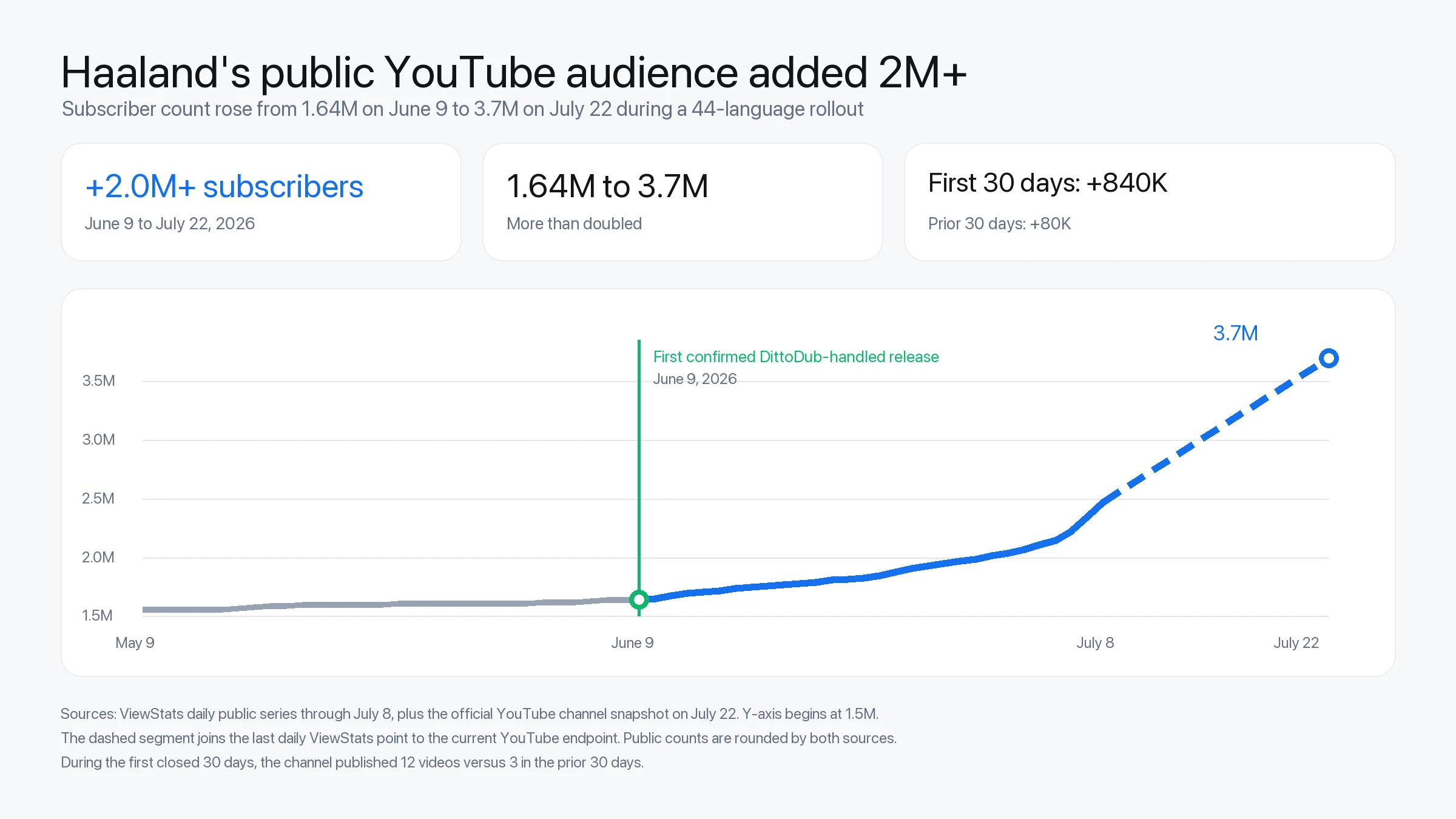
What the Public Curve Shows
ViewStats shows 1.64 million subscribers on June 9 and 2.48 million on July 8. The official channel displayed 3.7 million on July 22. The first closed 30 days added 840,000 subscribers, compared with 80,000 in the prior closed 30 days. The public count then added more than 1.2 million over the following 14 days.
The World Cup supplied extraordinary attention, the channel published more often, and the 44-language rollout made each release available across markets on one owned account. The useful creator lesson is to have the publishing and localization system ready before attention peaks.
Why Dubbing Makes Sense for Haaland
Football already crosses borders. Fans can understand the stakes of a match, a training session, or a travel vlog before anyone speaks. Language becomes most important in the moments around the action: the jokes, reactions, explanations, and personality that turn a famous player into a creator people want to keep watching.
Dubbing helps carry those moments beyond the audience that is comfortable with the original language. It gives more fans a direct way into the story without asking them to split their attention between the action and subtitles.
What the Language Menu Tells Viewers
Depending on the upload, viewers can encounter dubbed audio in languages such as Arabic, German, Spanish, French, Hindi, Norwegian, and Portuguese. The exact mix can vary by video, which is normal for a thoughtful localization strategy. Different topics and release moments may be more relevant to different audiences.
The important point is not the size of the language menu. It is the experience the menu creates. A fan can stay on the official upload and hear the story in a familiar language, while the channel keeps its audience around the same piece of content.
Why Same-Channel Dubbing Matters
YouTube's multi-language audio feature lets creators attach dubbed tracks to the original upload. The video keeps its comments, engagement history, thumbnail, and place in the recommendation system. Viewers can switch audio from the player instead of searching for a separate translated copy somewhere else.
For a personality-led channel, that consistency matters. The audience sees the same branding and the same conversation around the video. Localization expands access without fragmenting the creator's public presence.
Dubbing Works Best as Part of the Release
Haaland's channel also illustrates a broader localization principle: dubbed audio is strongest when it is planned alongside publishing. Sports content often follows live attention around matches, tournaments, travel, and cultural moments. If localized audio is ready while that interest is active, international viewers can participate in the same conversation.
The same principle applies beyond sports. A creator launching a series, documenting an event, or revisiting a proven video can decide which audiences matter before release and prepare the language experience as part of the package.
The Voice Still Has to Feel Like Haaland
Good dubbing is not only accurate translation. It has to preserve intent, pacing, humor, and personality. Haaland's on-camera appeal depends on an informal, direct style, so a stiff or overly literal performance would create distance even if every sentence were technically correct.
A strong dub should sound natural to the target audience while staying faithful to the speaker's energy. That balance is what makes localization feel like part of the original content rather than an extra layer placed on top of it.
$$$SUCCESS_STORY_TEASER_BLOCK$$$What Other Creators Can Learn
- Treat localization as distribution. Decide how international viewers will experience a video while planning the release, not after the moment has passed.
- Keep the audience together. When the platform supports selectable audio, use the original upload as the shared home for viewers across languages.
- Choose languages with purpose. Audience geography, topic relevance, cultural context, and past viewing behavior are more useful than chasing the longest possible menu.
- Adapt the performance, not just the words. The translated script and voice direction should protect the creator's tone, humor, and rhythm.
- Learn from language-level behavior. Creators can use their own private analytics to understand where localized audio improves watch time, retention, and return viewing.
A Note on What Can Be Observed
Public audio menus and channel presentation can show that a localization strategy exists, but they cannot reveal private account analytics, internal production volumes, costs, or the precise effect dubbing had on channel performance. Those details should not be inferred from the outside.
This analysis is based on publicly visible channel features and established dubbing principles. It does not rely on private account information, and it should not be read as an endorsement statement from Haaland or his team.
The Bottom Line
Haaland's public YouTube presence demonstrates a durable idea: global recognition creates attention, but localization helps make that attention feel personal. By pairing a main channel with selectable dubbed audio, a creator can welcome international viewers without asking them to leave the original content experience.
The strategy is useful because it is simple to understand and broadly applicable. Plan dubbing with the release, choose languages intentionally, protect the creator's voice, and make it easy for viewers to stay with the story.
$$$WALL_OF_TRUST_CTA$$$Common Questions
What happened to Haaland's public subscriber count during the rollout?
The public count rose from 1.64 million on June 9 to 2.48 million on July 8 and 3.7 million on July 22. That is more than 2 million subscribers added from the June 9 baseline at the precision the public sources display.
Which languages can viewers hear on Erling Haaland's YouTube videos?
Depending on the upload, publicly available audio options may include Arabic, German, Spanish, French, Hindi, Norwegian, and Portuguese. The exact selection can vary by video.
Why is dubbing a natural fit for Haaland's channel?
Football has an international audience, and much of the action is already visually understandable. Dubbing makes the personality, humor, reactions, and context around that action more accessible to viewers who prefer another language.
Does YouTube multi-language audio require separate channels?
No. Selectable audio tracks can live on the original YouTube upload, allowing viewers across languages to share the same video page, comments, branding, and recommendation history.
What matters more than the size of a language menu?
The language choices should reflect real audience relevance, and each dub should sound natural while preserving the creator's personality. A purposeful, well-performed localization is more valuable than adding languages without a clear audience strategy.
Is this analysis based on private Haaland account data?
No. It is based on publicly visible channel features and general dubbing principles. It does not use private account analytics, internal production records, or rollout totals.
What should creators learn from Haaland's dubbing strategy?
Plan localization with the release, keep viewers on the main upload, choose languages intentionally, preserve the creator's voice, and use private language-level analytics to improve future decisions.